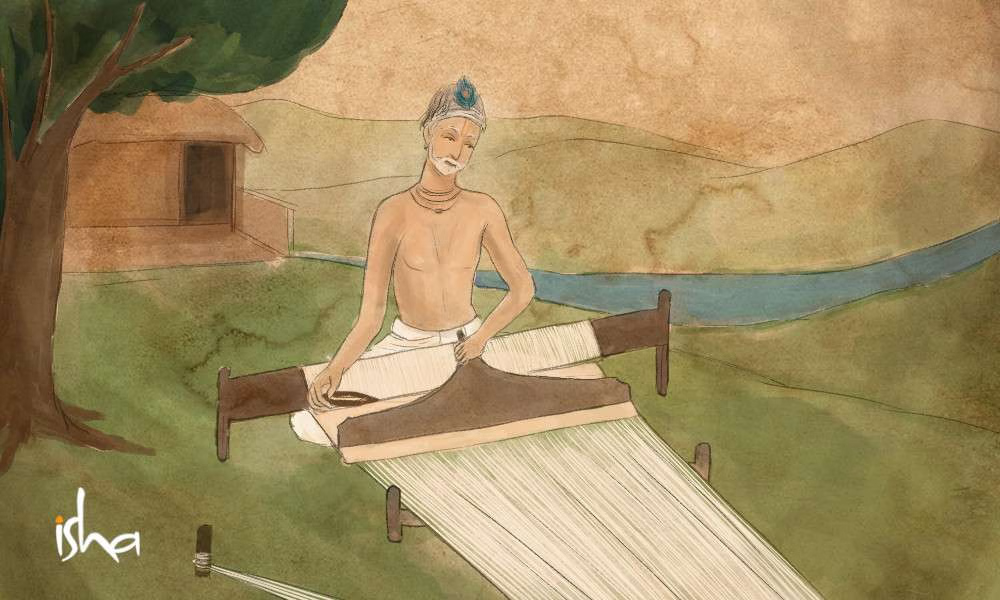
Awakening Beyond the Veil: The Union of Soul and Divine
In the poignant words of Kabir, "It is but an empty dream, that the soul shall have union with Him because it has passed from the body." This statement invites us to reflect on the nature of spiritual union and the misconceptions surrounding it. Kabir challenges the notion that mere physical death guarantees a connection with the divine, urging us to consider the depth of our spiritual practice while we are still embodied. The stakes are high; understanding this teaching can transform our approach to life and death, prompting us to seek genuine union with the divine through our actions and intentions rather than through the inevitability of mortality.
As we delve deeper into Kabir's wisdom, we uncover a profound truth about the nature of existence and the soul's journey. The idea that one can achieve union with the divine simply by shedding the physical form is a seductive but ultimately misleading notion. Kabir's assertion compels us to recognize that true spiritual connection requires conscious effort, devotion, and a sincere heart. It is a call to awaken to the present moment, to engage in the practices that cultivate love and understanding, and to realize that the journey toward union is as significant as the destination itself.
The image / the metaphor
At the heart of Kabir's quote lies a striking metaphor that juxtaposes the physical and the spiritual. The imagery of the soul passing from the body evokes a sense of transition, yet Kabir emphasizes that this transition alone does not suffice for true union with the divine. The verbs "shall have" and "passed" suggest a passive approach to spirituality, one that relies on the inevitability of death rather than the active pursuit of divine connection. This imagery serves as a reminder that spiritual awakening is not a mere consequence of physical demise but a lifelong journey of devotion and practice.
Diving deeper into the metaphor, we can see that Kabir's words challenge us to reconsider our understanding of life and death. The "empty dream" signifies the illusions we hold about spirituality—believing that simply existing or waiting for death will lead us to enlightenment. Instead, Kabir invites us to engage in a dynamic relationship with the divine, one that requires our active participation and commitment. The metaphor thus becomes a call to action, urging us to cultivate our inner lives while we are still in the realm of the living.
In the speaker's tradition
Kabir's teachings are rooted in the bhakti tradition, which emphasizes personal devotion to the divine as a means of attaining spiritual realization. Central to this tradition is the concept of bhakti itself, which signifies a deep, loving devotion that transcends ritualistic practices. Kabir's assertion resonates with the idea of kenosis, or self-emptying, where the soul must relinquish its attachments to the material world to experience true union with the divine. This aligns with the broader spiritual principles found in various traditions, such as the Buddhist concept of sunyata (emptiness) and the Sufi notion of fana (annihilation of the self).
In the context of Kabir's teachings, we can draw parallels with the Bhagavad Gita, where Krishna emphasizes the importance of selfless action and devotion. In Chapter 9, verse 22, Krishna assures that those who are devoted to Him will have their needs fulfilled, underscoring the significance of active engagement in one's spiritual journey. Kabir, much like Krishna, implores us to recognize that the path to union is paved with sincere devotion and conscious effort, rather than passive expectation.
Living the teaching
Consider a modern scenario where an individual grapples with the loss of a loved one. In the wake of grief, it is easy to fall into the belief that the departed soul has achieved a divine union simply by leaving the physical realm. However, Kabir's teaching invites us to reflect on the nature of that relationship and the love that was shared. Instead of viewing death as an endpoint, we can honor the connection by engaging in practices that celebrate that love—through remembrance, acts of kindness, or creative expressions that keep the spirit alive. This active engagement transforms our understanding of loss into a pathway for spiritual growth.
In another context, consider a relationship that is strained or filled with misunderstandings. Kabir's wisdom can serve as a guiding light, reminding us that true union with others—and ultimately with the divine—requires effort and intention. Instead of waiting for the other person to change or for circumstances to improve, we can embody the principles of bhakti by actively seeking reconciliation, practicing forgiveness, and expressing love. This approach not only nurtures our relationships but also deepens our spiritual practice, reinforcing the idea that union is cultivated through our actions in the world.
A reflection
As we contemplate Kabir's profound insight, we are left with a contemplative question: How can we actively engage in our spiritual practices to foster a deeper connection with the divine in our daily lives? This inquiry invites us to reflect on our current practices, our relationships, and our understanding of life and death. By embracing this question, we open ourselves to the transformative potential of Kabir's teachings, allowing them to guide us toward a more meaningful and engaged spiritual existence.



Join the BrightStar Community
Stay connected with daily inspiration, event announcements, and community wisdom